


A share price is the most recent price at which a buyer and a seller agreed to trade. On the London Stock Exchange, that agreement can happen thousands of times per session, and each transaction resets the displayed price. The price you see on a screen at any moment is a snapshot of the last deal, not a fixed value attached to the company.
How the order book sets the share price during continuous trading
During continuous trading hours, the London Stock Exchange runs an electronic order book where buy orders (bids) and sell orders (offers) queue by price and time. When the highest bid meets the lowest offer, a trade executes and a new price prints.
Further reading: The Role of Stockbrokers in Share Trading
If a cluster of buy orders arrives and the existing offers are thin, the price rises because buyers must accept progressively higher asking prices to get filled. The reverse happens when sellers outnumber buyers: offers drop to meet lower bids.
Two details matter here. First, the size of orders affects movement. A single large institutional order can sweep through several price levels in the book, shifting the price more than dozens of small retail orders would. Second, UK-listed shares may trade through different venues and execution methods, so activity on the London Stock Exchange order book alone does not show the whole market. A share’s displayed price can therefore vary slightly depending on where and how it trades.
Further reading: How Interest Rate Changes Affect Share Prices
Why liquidity changes throughout the session
Trading volume tends to concentrate near the open and the close, with a quieter stretch around midday. During low-liquidity periods, even modest orders can push the price further than the same orders would at busier times. This is one reason a share might drift a few pence on barely any news during the early afternoon, then move sharply again before the close.

News, earnings and the speed of intraday price reactions
Company-specific news is the single most visible catalyst for intraday price movement. Earnings releases, profit warnings, director dealings and regulatory announcements all land via the Regulatory News Service during the trading day.
A study of London Stock Exchange shares found that reactions to company-specific news began immediately after disclosure, with volatility and trading volume responding particularly strongly. The market does not wait for analysts to publish a note; algorithmic systems and attentive traders reprice the stock within seconds.
Broader macroeconomic data works the same way on a sector or index level. An unexpected interest-rate decision from the Bank of England, for instance, reprices rate-sensitive stocks across the board almost instantly.
Types of events that move share prices intraday
- Scheduled earnings reports or trading updates released during market hours, which force a rapid reassessment of the company’s value
- Unscheduled announcements such as profit warnings, takeover approaches or regulatory investigations, which catch the order book off-guard and widen the bid-offer spread
- Macroeconomic releases (inflation figures, employment data, central-bank decisions) that shift expectations for entire sectors at once
- Moves in related markets, particularly large US index futures that begin trading while London is still open, feeding sentiment back into UK-listed shares
Overnight returns versus intraday returns on share prices
Research has shown that intraday trading volume relates more closely to overnight returns than to returns generated later in the same session. In practical terms, a stock that gaps higher at the open on strong overnight demand does not necessarily keep climbing during continuous trading.
The pattern has a straightforward explanation. Retail traders and smaller firms often react to after-hours news by placing orders before the market opens. When the opening auction matches those orders, the price jumps. Larger institutional participants then assess whether the move is justified, and if they begin selling, the price can retrace during the day.
For an investor watching a stock spike at 8:00 a.m., this distinction is worth understanding. The opening price already reflects a burst of demand; the rest of the session may tell a different story.
Closing auction: why the official close price can differ from the last continuous trade
This is the detail that surprises many investors. The official closing price on the London Stock Exchange is not simply the last price printed during continuous trading. It is determined by a separate closing auction that runs after continuous trading ends.
During this auction, buy and sell orders accumulate without executing. The exchange’s algorithm then calculates the single price at which the maximum volume of shares can trade, and all matched orders execute at that price simultaneously.
Why the closing auction matters for investors
Index funds and tracker products typically benchmark to the official closing price. That concentrated demand in the auction can push the closing price above or below the level at which shares were changing hands just minutes earlier during continuous trading.
An investor who placed a market order at, say, 4:25 p.m. during continuous trading might have dealt at a price several pence different from the official close published five minutes later. The two prices reflect different pools of supply and demand meeting under different rules.
- Continuous trading matches orders one by one as they arrive, so price moves incrementally with each trade
- The closing auction batches all orders and finds a single equilibrium price, meaning large index-rebalancing flows can tilt that price in one direction
- The gap between the last continuous trade and the auction price is usually small on liquid FTSE 100 stocks, but it can be more pronounced on less liquid shares
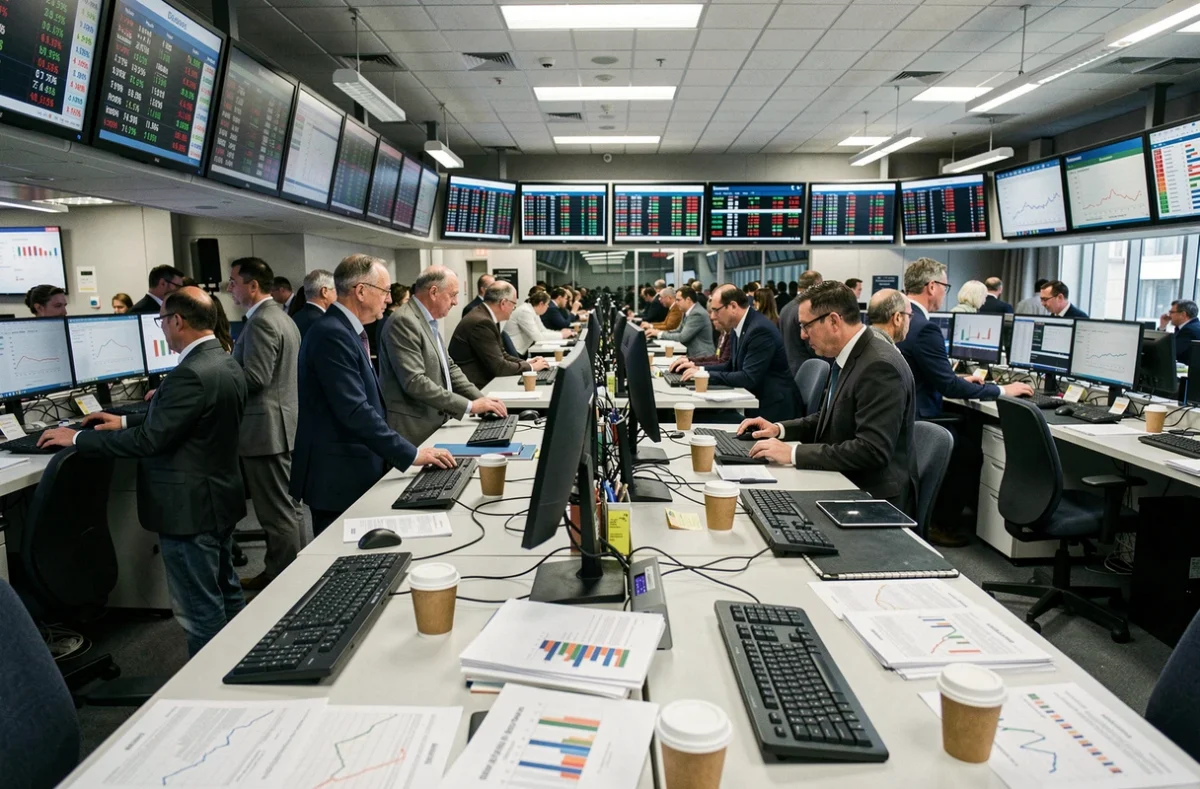
Sentiment, momentum and feedback loops in daily share price moves
Supply and demand explain the mechanism, but investor sentiment shapes the direction. During a session, traders interpret the same piece of news differently depending on their time horizon, risk tolerance and existing positions.
Short-term momentum plays a measurable role. When a share price rises through a technical level that many traders watch (a previous high, a round number, a moving average), it can trigger a cluster of buy orders, accelerating the move. The price rise itself becomes a signal, drawing in more buyers. The same feedback loop works in reverse when a support level breaks.
None of this contradicts the fundamental value of the company. Over weeks and months, share prices tend to converge on what earnings and assets justify. Within a single day, though, price moves often overshoot in both directions before settling. The closing auction then stamps a final price that may quietly correct the last bout of momentum from continuous trading.
Understanding that a share price is repriced continuously, by different participants, through different venues, and finally locked in by a distinct auction process, removes much of the mystery from daily fluctuations. The price moved because someone traded, and each trade carried its own reasoning, timing and urgency.





