


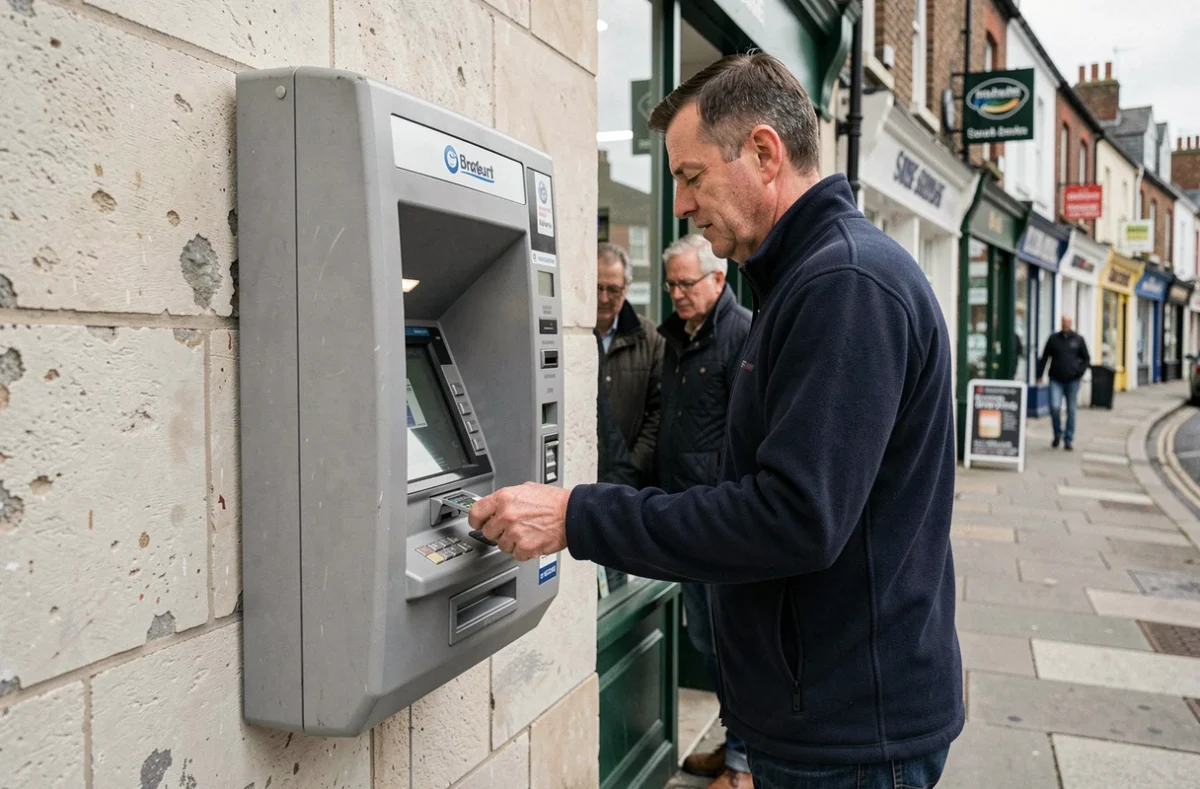
When a bank branch shuts in a market town, the first worry is usually whether there is still somewhere to draw out cash. That question now has a partial statutory answer. Under the Financial Services and Markets Act 2023, the FCA can require designated firms to assess and address significant gaps in cash withdrawals and deposits.
The operative word is “cash access”, not “branch preservation”. For the person queuing at a Post Office counter the difference may feel academic, but for the newsagent trying to deposit a weekend’s takings it is anything but.
Related reading: How Bank Overdrafts Work and What They Cost
Cash deposits for small businesses after bank branch closures
A florist in a town that has just lost its last branch faces a specific problem. Withdrawing notes from a free-to-use ATM is straightforward enough. Depositing the day’s takings is a different matter entirely.
Evidence submitted to the Treasury Committee in January 2025 reported that Post Offices had seen increased cash deposits following local branch closures. The same evidence, though, recorded concerns about cash-deposit fees higher than at bank branches, handling costs, security risks on the journey to alternative locations, and the difficulty of travelling to another town to bank the money.
Related reading: The Main Differences Between High Street and Online Banks
This is the gap the statutory framework does not automatically close. The FCA’s rules require consideration of effects on people and cash-accepting businesses, including vulnerable users, travel time and cost, and whether nearby facilities have enough capacity. Opening hours factor in too. A Post Office that closes at half past five may technically offer deposit services, but a takeaway owner cashing up at ten at night cannot use it.
Banking hubs: shared counters, not full-service branches
Banking hubs are the most visible piece of the replacement infrastructure. Run through shared counter services, they let customers of multiple banks carry out basic transactions in one location and speak to Community Bankers on a rotating schedule.
Around 14,000 responses collected through tablets inside hubs have fed back reported satisfaction figures. That is a useful data point, but it measures something narrower than whether hubs replace a full-service branch. It captures the views of people who walked in and used the tablet, not those of every affected resident, and not every banking need a branch once covered.
What hubs do well:
- Personal withdrawals and balance checks for customers of participating banks, without needing to travel to the next town.
- Face-to-face contact with a Community Banker, which matters for customers who struggle with app-based banking or need help with a specific query.
- Shared premises keep running costs lower than a standalone branch, making it more likely the service stays open in smaller communities.
What hubs do not resolve is the full range of business banking. A sole trader who needs to order coin floats, pay in a bag of mixed notes, or resolve a payment dispute still faces friction that a traditional branch handled in one visit.
FCA cash access rules: what the local assessment actually covers
The statutory regime is more granular than a simple “is there an ATM nearby” check. FCA rules require a local assessment to weigh several factors before deciding whether a gap in provision is significant.
- The effect on vulnerable users, including elderly residents and people with disabilities who may not be able to travel easily.
- Whether remaining facilities have enough capacity to absorb displaced demand, taking into account opening hours.
- Travel time and cost to the nearest alternative, not just straight-line distance.
- The impact on businesses that rely on cash, including the viability of depositing takings locally.
This framework gives communities a lever they did not have before. If a closure leaves a measurable gap, designated firms can be compelled to act. The limit is that the duty centres on reasonable access to cash, not on restoring every service a branch offered. Mortgage advice, foreign-currency orders, and complex account queries sit outside the scope.
Where capacity is the real bottleneck
A free-to-use ATM on a petrol station forecourt satisfies the withdrawal test on paper. It does not help when the machine runs dry on a Friday afternoon and is not refilled until Monday. Capacity, not just presence, is what determines whether access to cash is genuine. The FCA’s inclusion of opening hours and capacity in its assessment criteria acknowledges this, but enforcement depends on how rigorously assessments are carried out in practice.
The cost of handling cash: a pressure point for high street shops
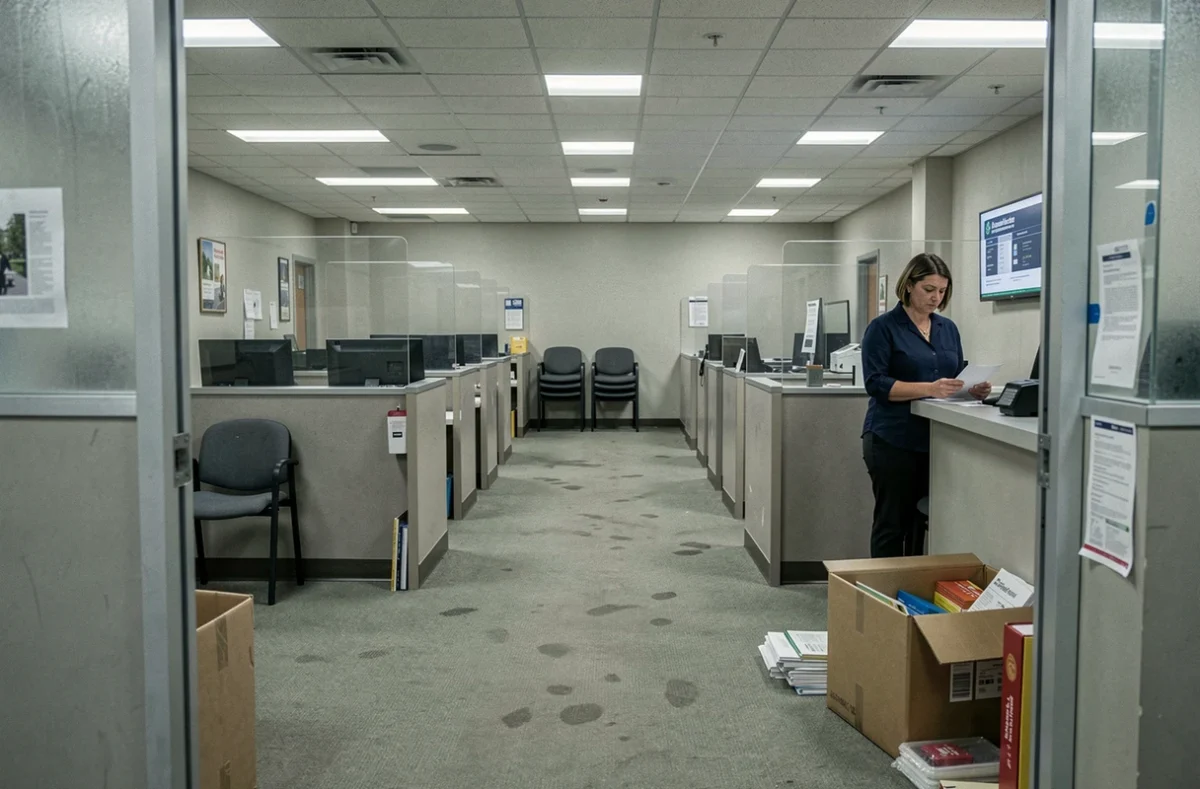
The policy conversation around bank branch closures tends to frame the problem from the customer’s side. Parliamentary evidence from January 2025 shifts the lens: businesses that accept cash also need affordable ways to bank it.
When a branch closes, a shop owner who previously walked two minutes to deposit takings may now drive to the next town, pay higher fees at a Post Office counter, or hold cash on site for longer, increasing insurance costs and security risk. For a business operating on thin margins, any of those changes can tip the calculation against accepting cash at all.
That feeds a cycle. Fewer shops accepting cash means fewer places for residents to spend it, which in turn weakens the case for maintaining local cash infrastructure. The January 2025 evidence to the Treasury Committee also captured disagreement over whether government should require businesses to accept cash, a measure that would be difficult to enforce without first solving the deposit-cost problem.
What actually helps after a high street bank closure
No single replacement matches what a staffed branch provided. The practical question is which combination of services covers the most ground for the least disruption.
Post Office counters remain the widest network. They handle withdrawals, deposits, and balance enquiries for most major banks. The constraints are withdrawal limits and deposit charges that vary by bank agreement, plus the fact that counter staff are not trained to advise on banking products.
Banking hubs add the Community Banker layer, which helps with queries that a Post Office cannot resolve. Their rollout, though, is concentrated in areas where closures have already been assessed as leaving a significant gap, so not every town that loses a branch will get one.
Cashback at the till, available without a purchase at many retailers since rule changes, covers small withdrawals but does nothing for deposits. It works for the customer picking up groceries; it is irrelevant for the cafe owner with a till full of coins.
The gap that remains is clearest for cash-heavy small businesses in towns where the last branch has gone and no hub has arrived. For them, the statutory regime guarantees the right to access cash, but the practical cost of exercising that right can still be high enough to change how they operate.





