


Cryptocurrency mining secures billions of pounds’ worth of digital transactions every day, yet most explanations stop at “computers solve puzzles.” The mechanics underneath, the energy trade-offs, and the emerging question of whether mining infrastructure could play a role in national electricity grids deserve a closer look. In the United Kingdom, a proposal to site Bitcoin mines near Scottish grid bottlenecks has pushed that question from theory into policy debate.
Proof of work and why cryptocurrency mining exists
Every Bitcoin transfer needs independent verification. Mining provides that verification without a bank or clearing house standing in the middle. Miners compete to validate a batch of transactions, package them into a block, and append that block to the blockchain.
Recommended read: Ways to Spot Common Cryptocurrency Scams
The competition works through a mechanism called proof of work. Each miner’s hardware repeatedly guesses a value, known as a nonce, that produces a cryptographic hash meeting a difficulty target set by the network. The first miner to hit that target broadcasts the solution, other nodes confirm it, and the winning miner earns the block reward, currently 3.125 BTC.
The difficulty target adjusts roughly every two weeks so that blocks appear at a steady pace regardless of how much computing power joins or leaves the network. This self-regulating cycle is what keeps the system decentralised: no single operator can dictate the pace of new coins or rewrite transaction history without controlling the majority of the network’s total hash rate.
Read also: A Beginner's Guide to Cryptocurrency Exchanges
Mining hardware and the electricity it demands
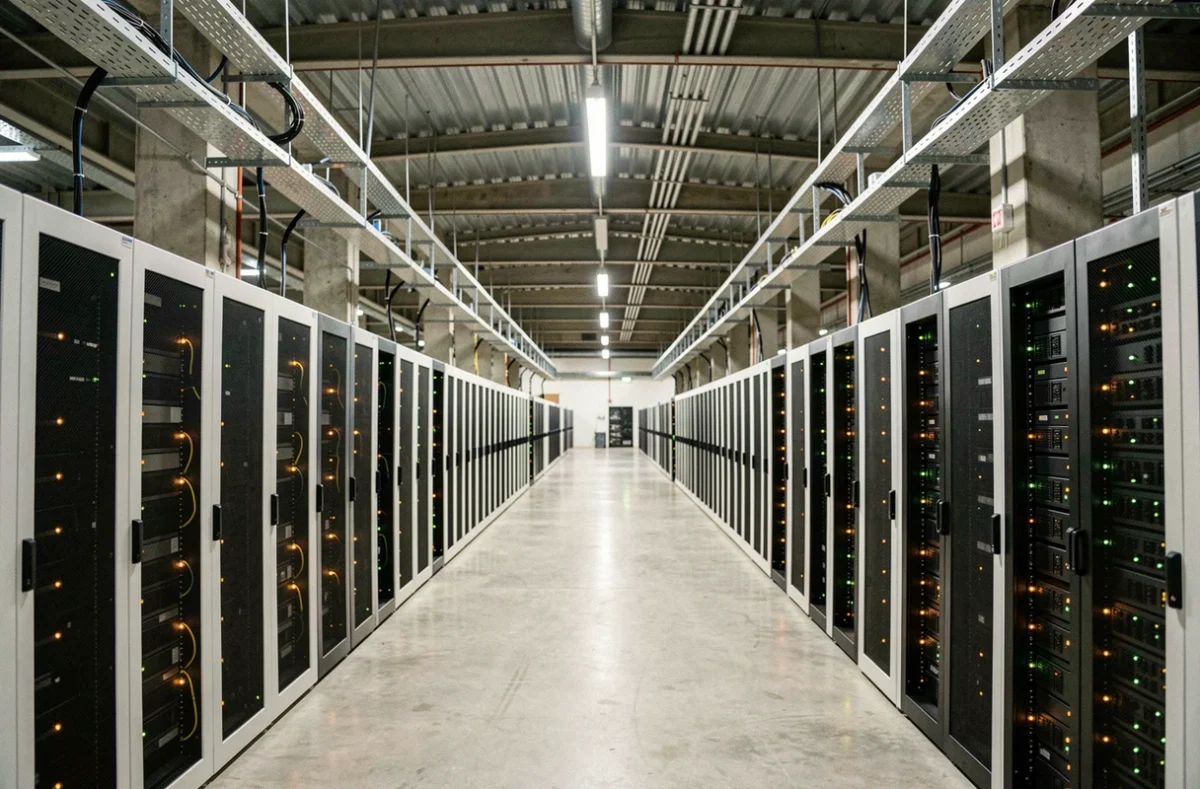
Early Bitcoin mining ran on ordinary desktop processors. That era ended years ago. Today, application-specific integrated circuits (ASICs) dominate, each chip designed for one task only: computing SHA-256 hashes as fast as possible.
An ASIC rig draws a substantial amount of electricity continuously. Multiply that by the thousands of units inside a commercial mining facility and energy consumption becomes the single largest operating cost. Cooling systems add further load, because densely packed hardware generates heat that must be removed to avoid thermal throttling.
- Electricity price per kilowatt-hour determines whether a facility turns a profit or runs at a loss, making location selection a strategic decision tied to wholesale energy markets.
- Hardware efficiency improves with each chip generation, but the network’s rising difficulty often absorbs those gains, keeping total energy demand on an upward trend.
- Pool mining, where participants share hash power and split rewards proportionally, has largely replaced solo mining for all but the largest operators because it smooths out the variance in earnings.
These economics explain why mining operations cluster in regions with cheap power, whether that comes from hydroelectric dams, stranded natural gas, or surplus renewable generation.
Bitcoin mining near Scottish grid bottlenecks: cost saver or cost shift?
The UK’s electricity transmission network faces a well-documented constraint: wind farms in Scotland frequently generate more power than the grid can carry south to demand centres in England. When that happens, generators are paid to reduce output, a process called curtailment, and the cost lands on consumer bills.
A proposal backed by the Bitcoin Policy Institute suggests that flexible Bitcoin mines sited near these bottlenecks could absorb surplus wind power that would otherwise be wasted. In principle, a mine would ramp up when excess generation is available and ramp down when the grid needs the electricity for households and businesses.
What the proposal gets right
There is evidence from other jurisdictions that mining operations can reduce their consumption quickly when grid operators signal a need for flexibility. A mine acting as an interruptible load could, in theory, lower the volume of curtailed wind and trim constraint payments.
What the proposal leaves open
Grid flexibility at a single point in Scotland is not the same as solving the UK’s wider electricity-constraint costs. Even if a mine reduced local curtailment, it would not by itself deliver power to southern demand centres where consumption peaks. The constraint is a transmission problem, not a generation problem. A mine consuming power locally does not add a single megawatt of transfer capacity southward.
Several practical questions remain unanswered:
- Would the mine have a grid connection large enough to absorb meaningful volumes of surplus wind, and what would that connection cost to build?
- Would enough operating hours at low electricity prices exist to make the facility commercially viable without subsidy?
- Could the energy consumed by the mine displace other potential uses of that surplus, such as green hydrogen production or battery storage, that might offer broader public benefit?
- Who bears the cost if the mine increases local grid congestion during periods when it does not curtail its own demand?
The UK’s new Data Centre Covenant sets out expectations for large-scale digital infrastructure around energy efficiency and community impact. The covenant does not specifically classify cryptocurrency mines, so whether a mining facility would fall under its terms is not yet settled. Any operator planning a Scottish site would need clarity on that point before committing capital.

Regulatory position in the United Kingdom
Crypto assets in the UK sit inside a framework that has tightened considerably. The Financial Conduct Authority regulates crypto marketing and certain activities around crypto-asset services. Mining itself, the act of running hardware to validate blocks, is not a newly FCA-regulated activity. The regulatory focus is on the financial products and services built around crypto rather than on the computational process that underpins the network.
That distinction matters for anyone evaluating the feasibility of a UK-based mining operation. A miner selling hash power or running a pool may face different obligations from a miner simply holding the coins it earns. Regulatory clarity on mining’s classification remains incomplete, which adds a layer of uncertainty to long-term investment decisions.
Environmental trade-offs and what the data does not yet show
Critics point to the total electricity consumed by proof-of-work networks. Defenders counter that a growing share of mining runs on renewable energy. Both claims carry weight, but neither settles the question for the UK specifically.
No published dataset confirms how many operating hours a hypothetical Scottish mine would run on genuinely surplus wind versus drawing from the grid alongside other consumers. Without that data, the environmental case for UK-based mining rests on modelled scenarios rather than observed outcomes. The gap between a pilot proposal and a proven UK business case is wide.
Mining’s energy debate also sits alongside a broader shift in blockchain design. Ethereum moved to proof of stake in 2022, eliminating its mining requirement entirely. Bitcoin’s community has shown no appetite for a similar switch, so the energy question will persist for the largest proof-of-work network.
For the UK, the practical test is whether mining can offer grid benefits that outweigh the costs it creates, measured not in white papers but in metered data from real facilities operating under real grid conditions. Until that evidence exists, the proposal remains exactly that: a proposal, not an adopted policy or a confirmed route to lower bills.





