


Properties built on or after 1 January 2009 sit outside the Flood Re scheme. For buyers eyeing a newer home in a flood-prone area, that single eligibility cut-off reshapes the entire insurance calculation, from premium levels to the availability of cover itself. Understanding where the scheme stops is the starting point for any realistic assessment of household flood risk in the UK.
Post-2009 properties and the Flood Re eligibility cut-off
Flood Re caps premiums and excesses according to council tax band, and over 40 insurers participate. The scheme was designed to support existing housing stock, so homes built from 1 January 2009 onwards are excluded regardless of their flood exposure. The rationale is straightforward: developers who built after that date should have accounted for flood risk in site selection and design. In practice, that assumption does not always hold.
You may also like: How to Choose the Right Home Insurance for Your Needs
Oral evidence presented to the UK Parliament in November 2026 raised concerns that current planning policy may still allow development in high-risk areas. Where local authorities grant permission for housing on flood-prone land, the resulting properties enter the open market without the safety net Flood Re provides to older homes.
For a buyer, this creates a concrete problem. A pre-2009 terrace on the same street may qualify for capped flood cover, while a new-build next door does not. The newer property’s insurer prices flood risk at full commercial rates, or declines cover for the flood peril altogether. Before exchanging contracts on any post-2009 home, requesting a flood risk assessment by postcode through the Environment Agency’s long-term flood risk tool is a minimum step.
Read also: Travel insurance for UK holidaymakers: cover for delays and cancellations
What else falls outside the scheme
Beyond the build-date rule, Flood Re excludes commercial properties, buy-to-let homes, and properties in council tax band H (the highest band). Static caravans are also ineligible. If you are purchasing a leasehold flat in a post-2009 block, you have no route into the scheme for the building’s policy, though a tenant can insure personal contents through a participating insurer if the property otherwise qualifies.
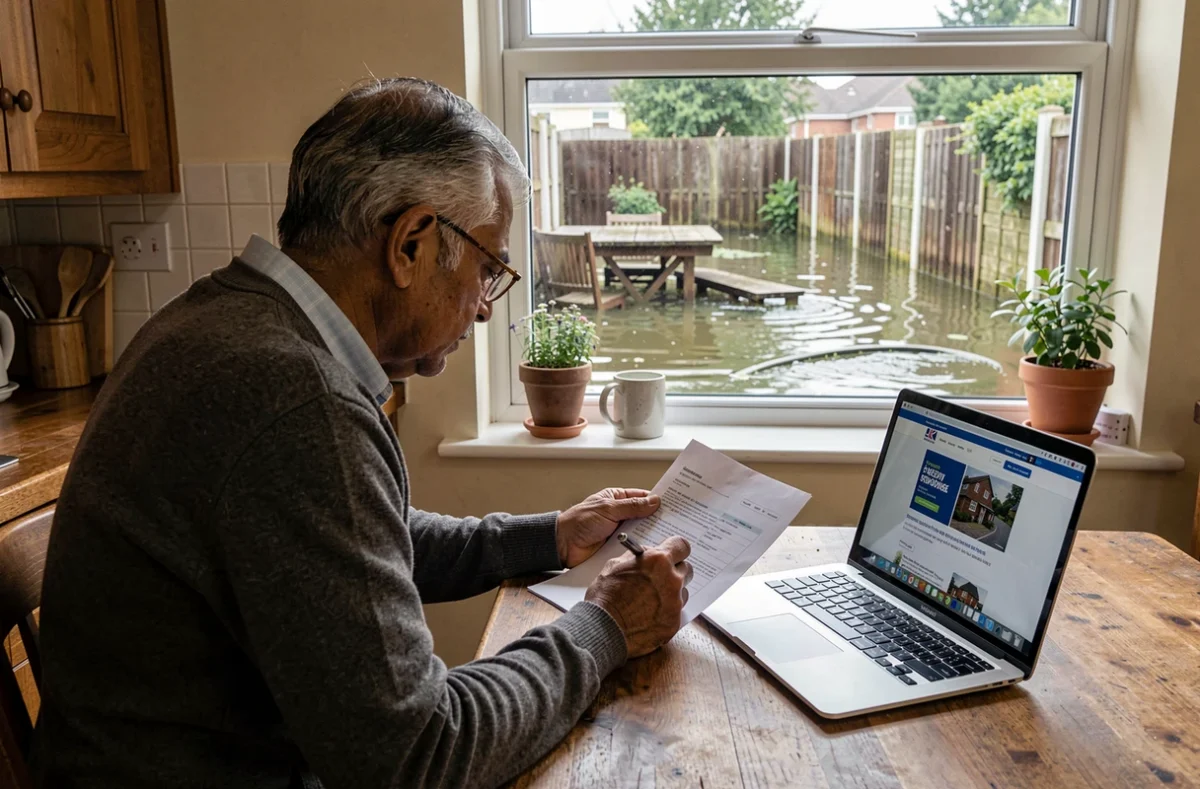
Surface-water flood risk: the exposure most policies understate
Surface-water flooding now threatens a growing share of UK homes, and the risk is projected to affect around 6 million properties by 2050. River and coastal flooding dominate public awareness, but surface water, driven by intense rainfall overwhelming drainage, accounts for a substantial portion of actual claims.
The Environment Agency’s updated assessment tools now let householders check risk by postcode across river, coastal, and surface-water categories separately. That granularity matters because a standard home insurance quote often references river or coastal flood maps without distinguishing surface-water exposure. A property rated low-risk for river flooding may still sit in a surface-water hotspot.
When comparing quotes, ask the insurer explicitly whether the flood peril wording covers surface-water ingress. Some policies treat it as a named sub-peril; others fold it into a general “storm and flood” section with different excess structures. The distinction affects what you can claim and how much you pay out of pocket.
Build Back Better: flood resilience after a claim
Flood Re’s Build Back Better initiative allows policyholders to spend up to a capped amount on property-level resilience measures during reinstatement after a flood claim. Measures include flood doors, raised electrics, waterproof plastering, and non-return valves on drainage. The idea is sound: each claim becomes an opportunity to reduce the cost of the next flood.
Uptake, however, remains limited despite availability from many participating insurers. Evidence submitted to the UK Parliament’s Environmental Audit Committee in late 2026 confirmed that reported use of the scheme is low relative to the number of eligible claims. The gap sits partly with loss adjusters and contractors unfamiliar with resilience specifications, and partly with homeowners unaware they can request it.
- Confirm with your insurer at policy inception, not after a flood, whether Build Back Better applies to your cover and what spending cap exists.
- Instruct the loss adjuster in writing to include resilience measures in the scope of reinstatement works.
- Keep receipts and specifications for every resilience item fitted, as these can support future premium negotiations with any insurer.
Flood Re’s 2039 end-date and what it means for long-term cover
The scheme is legislated to run until 2039. After that, the flood insurance market is expected to operate without a reinsurance backstop. The Association of British Insurers, in written evidence to Parliament in October 2026, argued that progress on flood defences and property-level resilience is critical to making that transition viable.
For current homeowners, the 2039 horizon is relevant in two ways. First, a property that relies on Flood Re today may face sharply higher premiums after the scheme closes if no resilience improvements have been made. Second, mortgage lenders may begin factoring the scheme’s end-date into lending decisions on high-risk properties within the next decade, particularly for 25-year terms that extend past 2039.
We expect the transitional period to bring increased scrutiny of property-level flood resilience during conveyancing. Buyers purchasing in flood-risk areas now should treat resilience investment not as optional but as a condition of maintaining insurability beyond the scheme’s lifetime.
A new property-level risk information tool
The UK Government announced in October 2026 work on a property-level risk information tool designed to give more precise flood data than current postcode-level checks. If delivered, it would let buyers and insurers assess individual buildings rather than broad zones, potentially lowering premiums for well-protected homes and raising them for exposed ones. No launch date has been confirmed.
Practical steps before buying a home in a flood-risk area
- Check the property’s build date against the 1 January 2009 Flood Re cut-off. If the home post-dates it, budget for commercial-rate flood premiums or the possibility of cover being declined.
- Run the Environment Agency’s long-term flood risk check for river, coastal, and surface-water categories. A single “low risk” label may mask exposure in one category.
- Request flood history from the seller and the local authority. Previous claims data, even if the property was repaired, shapes future insurability.
- Ask insurers whether Build Back Better provisions are included and what the resilience spending cap is before you need to claim.
- For properties currently covered under Flood Re, model what premiums might look like after 2039, and factor resilience upgrades into your purchase budget.
Flood cover in the UK is not a single product but a patchwork of scheme eligibility, peril definitions, and transitional timelines. The gap between what Flood Re provides and what the open market offers is widest for newer properties in high-risk zones, precisely the homes where buyers most need clarity before committing.





