


Running a single ASIC miner from a spare room in Manchester costs roughly the same in electricity as heating a small flat through winter. That comparison matters because most UK mining guides focus on the tax return and gloss over the question that decides whether you ever file one at all: can you actually get enough affordable power to mine profitably, and can you get it where you need it?
Grid connection bottlenecks and UK crypto mining viability
Electricity price per kWh is the number every mining calculator asks for. It is not, on its own, the number that determines whether a larger operation can exist in the UK.
Read also: How Cryptocurrency Tax Rules Affect UK Investors
In its 2026 response on electricity connections, the UK Government acknowledged that demand connections are under acute pressure, with data-centre applications contributing to oversubscription. The policy intends to prioritise certain strategic demand projects and, after 2030, align data-centre connections with regional infrastructure targets. That framework targets data centres rather than crypto miners explicitly, but the practical effect is the same: securing grid capacity matters as much as the unit cost of power.
Evidence submitted by NESO to Parliament in November 2026 reported around 72.8 GW of data-centre connection requests through to 2039, while warning that project attrition and uncertain utilisation make eventual demand uncertain. For anyone planning a mining facility that draws more than a domestic supply can handle, this queue is the real bottleneck. Applications and requested capacity should not be confused with facilities that will actually connect or consume power.
You may also like: Crypto tax in the UK: capital gains and HMRC reporting in 2026
Flexible mining near Scottish wind curtailment
A November 2026 report covered a Bitcoin Policy Institute proposal to explore mining near transmission bottlenecks in Scotland, where wind power is regularly curtailed. The argument is that miners could absorb surplus generation and reduce consumption when the grid needs capacity back.
This is a system-service model, not a shortcut to cheap electricity. Miners cannot automatically access curtailed wind power or earn revenue from doing so without formal agreements with network operators. Treating “curtailed Scottish wind” as a cost assumption in a spreadsheet, without confirming connection availability and commercial terms, is a planning error rather than a strategy.
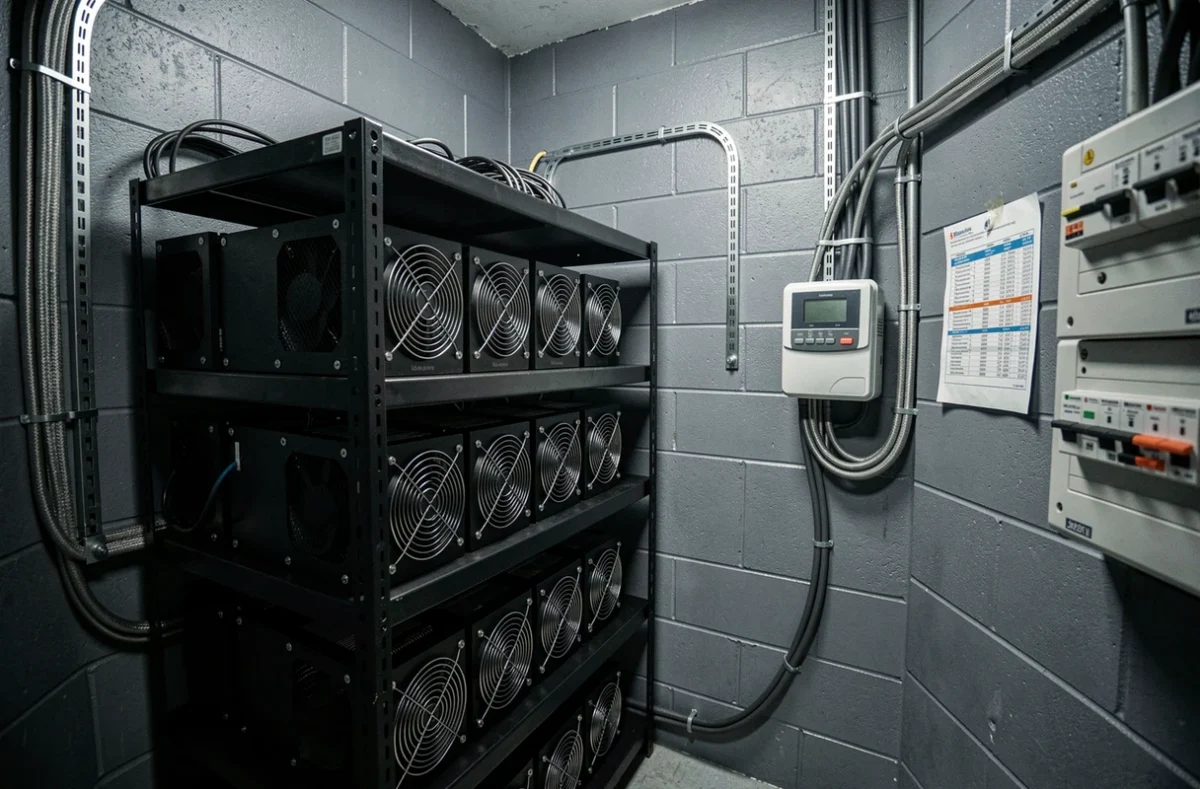
UK electricity costs for Bitcoin mining: domestic versus commercial rates
Domestic electricity tariffs in Great Britain remain among the highest in Europe for residential consumers. The standing charge and unit rate together make home mining a marginal activity for most people, particularly once you factor in the noise and heat output of modern ASIC hardware running around the clock.
Commercial and industrial tariffs can be meaningfully lower per kWh, but they come with their own complications. A business premises needs appropriate electrical infrastructure, planning permissions (depending on scale and noise), and a supply agreement that can handle sustained, constant load. We should also note that energy costs vary between suppliers and contract types, so any profitability calculation needs to use the actual tariff you can secure, not a national average.
The honest constraint is this: home miners pay residential rates with no realistic route to negotiate them down, while commercial operators face capital costs and lead times for connection that most guides do not mention.
Income tax and capital gains tax on crypto mining rewards
HMRC treats cryptocurrency received from mining as income. The classification depends on whether the activity amounts to a trade or remains a hobby, and HMRC’s broad expectation is that most individuals will fall into the hobbyist category.
- Hobbyist miners report the sterling equivalent of tokens received (valued on the date of receipt) as miscellaneous income, subject to income tax. Fees received for verifying transactions count within this mining income.
- If mining activity does amount to a financial trade, rewards are subject to income tax and National Insurance contributions, reported through Self Assessment (form SA100).
- When mined coins are later sold or exchanged, any increase in value between the date of receipt and the date of disposal may trigger a capital gains tax liability on the difference.
Allowable expenses, such as additional electricity consumed during mining, can be deducted. The trading allowance may also apply depending on the level of income. Keeping contemporaneous records of the fair market value in GBP at the moment each reward is received is not optional; it is the basis for every calculation HMRC expects.
Corporation tax for mining companies
Mining operations structured as limited companies pay corporation tax on profits. The timing and type of equipment expenditure may matter under capital-allowance rules, and HM Treasury’s Budget 2026 overview of tax legislation and rates (published 28 October 2026, updated 23 November 2026) is relevant here. Whether particular mining hardware qualifies for capital allowances needs professional advice specific to the business.
VAT position for mining operators
HMRC updated its VAT guidance for cryptoasset businesses in Agent Update issue 149, published 19 November 2026. The update does not create new VAT rules, but mining operators should check whether wider activities (supplying services, operating a platform) raise VAT questions rather than assuming that the mining reward alone settles the issue.

Deductible expenses and record-keeping for UK crypto miners
The gap between a profitable mining operation and an unprofitable one often sits in the expenses column rather than the revenue line. Electricity is the largest deductible cost, but it is not the only one.
- Electricity directly attributable to mining equipment, measured separately from general household or business consumption where possible.
- Hardware depreciation or, for companies, capital allowances on mining rigs and cooling infrastructure.
- Internet costs, proportionally allocated if shared with other uses.
- Professional fees for tax advice, particularly where HMRC’s hobby-versus-trade distinction is unclear.
Accurate, date-stamped records of every reward received and every expense incurred are the foundation. HMRC can enquire into crypto income, and reconstructing values months or years later from exchange-rate archives is both unreliable and stressful. Automated tracking through crypto tax software is one practical route, though we would still recommend checking its outputs against your own transaction logs.
Profitability reality check: energy costs versus mining rewards
Most UK miners are not competing with operations in jurisdictions where electricity costs a fraction of UK rates. The question is whether the specific coins you mine, at the specific tariff you pay, on the specific hardware you own, generate a net return after tax and equipment costs.
That calculation changes with the Bitcoin price, with network difficulty, and with your electricity contract renewal date. A setup that broke even in January can lose money by June if any of those variables shifts. Profitability is a rolling calculation, not a one-off forecast.
For anyone considering scaling beyond a single rig, the grid-connection constraints discussed earlier become the binding factor. Domestic supply has a ceiling, and commercial connection has a queue. The electricity cost per kWh is the last variable to optimise, not the first.





